
(An extract from Oneness: the Dynamics of Monasticism, ed. S.Platten, Canterbury Press 2017, Chapter 4 by Stephen Platten, © The Contributors 2017)
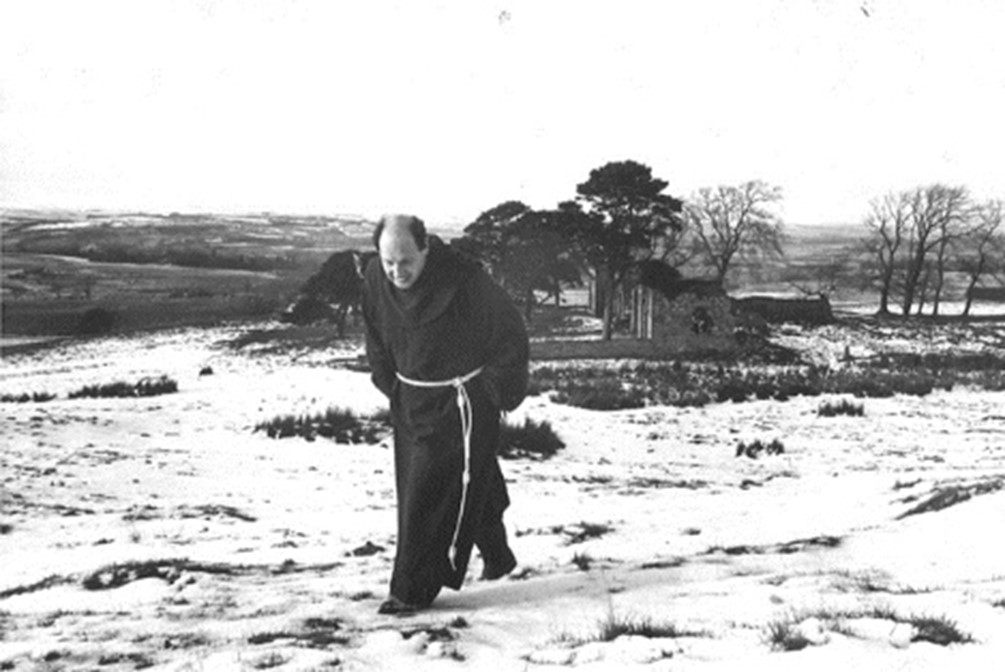
The starting point … had been the curate of the nearby village of Eglingham offering to drive Brother Harold round the countryside seeking out a suitable empty dwelling. Seeing Shepherds Law on the hill, he asked the accompanying priest about it and, even though the priest dismissed it as a ‘ruined shepherd’s cottage’. Harold said, ‘Let’s go up and have a look.’ They climbed the hill and on making their way round the corner of the ruined buildings they entered what had clearly been the farmyard of a now disused hill sheep farm. Harold notes:
‘Everything was in ruins and long abandoned, but I knew immediately
that I had come to the place I was looking for. There was no house to live in and my second thought was to dismiss this idea as an impossibility with which I could not cope.’
Various things happened which emboldened Harold to pursue the idea. Words from a visiting Sister gave him courage; quite separately, a parcel arrived containing a trowel, a square, a plumb-line and a surveyor’s measuring tape (doubtless the tape which I held with Harold on his second and more detailed exploratory visit); the French Capuchin friar referred to earlier stayed at the Friary in Alnmouth proposing the establishment of an ecumenical project of prayer for Christian unity. This final event provoked an initiative whereby Harold and Frère Jean Claude produced (with the assistance of Mother Mary Clare at Fairacres) a letter to each of their Superiors suggesting that ecumenical hermitages should be established in England and France to serve Christ and his Church in the search for visible unity during this present age. The English hermitage would be at Shepherds Law.
The site might initially have appeared to be impractical. There were, however, some factors in its favour. First, only two or three hundred yards up the hill from the ruins, there was a small covered reservoir which supplies the surrounding villages. This would make the supply of fresh water a relatively straightforward matter. Second, and partly on account of the need for access to the reservoir, there is a good trackway leading up to the abandoned farm. The track, running approximately eastwards from the road which runs from Bolton, past Titlington to Hedgeley and Beanley, is clearly part of an earlier route which was never adopted as a public highway, when roads came to be metalled in the late nineteenth and early twentieth centuries. Then there were some substantial protecting walls built in a mixture of gothic and classical style which would, with the small tree plantation, offer some protection on this exposed hillside. Access to the Glanton-Eglingham road was also fairly easy albeit down a steep hill. There was even a small quarry on that steep hillside from which the stone for Shepherds Law was hewn; that gave space for a tiny shed which housed Harold’s bicycle in the early days.
The next issue was to explore with the owner of Shepherds Law and the land surrounding it, what the possibilities might be. The Guardian of Alnmouth Friary at the time, Brother Edward SSF, was well known in the county and on good terms with local landowners. Brother Edward, alongside Harry Bates, who was not only Vicar of Eglingham but also conterminously Archdeacon of Lindisfarne, accompanied Brother Harold on a first visit to Sir Ralph Carr-Ellison, the owner of the site, who lived at nearby Hedgeley Hall. Carr-Ellison was a significant figure in the county and someone with a strong community involvement. Alongside having been High Sheriff of Northumberland, he had also been Chairman of Tyne-Tees Television, Chairman of the Board that oversaw the building of the great Kielder reservoir and indeed, on the national scene, Chairman of the Automobile Association. He had an excellent pedigree in public service and so the auguries were good. He agreed that Shepherds Law might be developed as a hermitage dedicated both to prayer and to the healing of Christian divisions between Rome and Canterbury. Furthermore, he allowed a trust to be established which would set the property within his farmland to be on a long lease at a peppercorn rent. An architect, who was a friend of the friars, agreed to draw up a simple restoration plan for the ruined cottage and planning permission was granted by the local authority. The only proviso that the chapter of the Society of St Francis had made was that Brother Harold should earn money to pay for the work required to provide accommodation at Shepherds Law; accordingly he went to work at a London hospital.
As all this proceeded, so Harold travelled to France to meet with the Paris Capuchin friars and visit some of their houses. He met also with the French Secretariat for Christian Unity who gained approval for the joint venture from the Vatican Secretariat in Rome. The equivalent to Shepherds Law was to be established in some abandoned farm buildings at La Roche Mabile, a small village close to Alençon in Normandy. So began the very rich twinning which continues to prosper some forty years on. Later, practical circumstances in France meant a move for Frère Jean Claude, who now lives near a small Marian shrine not far from Foix in the foothills of the Pyrenees south of Toulouse.
Meanwhile things began to move forward at Shepherds Law. An old green mission caravan was towed on to the site and, it would be fair to say, that a similar vehicle has adorned the site ever since, providing some ancillary accommodation. Harold was supported throughout this early period by the Archdeacon of Lindisfarne, Harry Bates, and his family at Eglingham Vicarage. On both Sundays and Fridays, Harold would appear for Holy Communion and, around this pattern, was built a regime of Eucharist, then bath, then breakfast, and finally walking the dog with Harry. The Bates, both of whom are buried just inside the churchyard gate at Eglingham became great friends and supporters of Harold in the early years. Harry died in 1980.
Young people came to assist with the building of the permanent accommodation. One of the great ‘wall-builders’ in the early days was Paul Guiver, a theological student at Cuddesdon College near Oxford. Paul later joined the Community of the Resurrection, Mirfield and now as Father George Guiver CR he is a noted author on the monastic life and indeed author of a classic book on the daily office, which owes much to reflection and conversation at Shepherds Law. Later, different parishes and churches offered either financial or manual support. The congregation at Portsmouth (Anglican) Cathedral contributed some funds to costs at one stage. St Mary’s, Monkseaton, under the leadership of Father John Lowen, contributed much both in energy and in material support. Sometimes, alongside their witness of prayer, when staying at Shepherds Law, friars from the Society of St Francis contributed in very practical ways: Brother Nathaniel SSF, almost single-handedly excavated and constructed the main drainage cess pit! The first buildings constructed at Shepherds Law used much of the stone which lay around on the site. Throughout the entire period of development until the present day, Harold himself has not baulked from engaging in the practical work. From laundry to washing up and cleaning, to chopping logs and making minor repairs – all this has been part of a day’s work.
But crucial too, of course, has been a very different sort of work, the work of God, the Opus Dei, that is the central pattern of prayer from dawn until dusk including not only Mattins and Evensong or Vespers, but the little hours and, of course, Compline or Night Prayer. When there has been a priest available, the Eucharist too has been celebrated, often beginning with the office of Sext at around noon. Moving on from his time as a Franciscan friar, Harold began to develop a more contemplative and monastic liturgy to serve the life of prayer. This was founded essentially on the work which Bishop Frere had completed for the Order of the Holy Paraclete at Whitby. Frere, who was one of the co-founders of the Community of the Resurrection with Bishop Charles Gore, was a pre-eminent Anglican liturgical scholar in the early twentieth century. The resulting liturgical pattern was essentially a coming together of elements of the old contemplative tradition of prayer with the forms and language of the Book of Common Prayer. The first chapel of the hermitage was set up in a small wooden hut placed near the caravan; with the help of Frère Jean Claude, this was replaced with a lean-to, built at the rear of the façade wall of the ruins, and topped by a corrugated iron roof. This chapel, which did duty until 1979, had a stone altar and a large wooden lectern. It was heated with a paraffin stove and an oil lamp from the chapel at Old Bewick was provided by the parish. Thereafter the chapel was transferred into the roof space of the now-completed dwelling house.

